Why England may destroy its world-leading education system.
, .
“Do you prefer the right outcome with the wrong process, or the wrong outcome with the right process?” asks Daisy Christodoulou.
She’s one of my favourite bloggers and certainly my favourite on education. She was writing about VAR. Her book on video assisted refereeing in football is excellent. But just as in the book, the topic was really much wider, including much on her specialist topic.
I’m on team process. And as a strong believer in devolution of government within Britain and England, my instinct is to strongly oppose the education reforms of the last 40 years on that basis.
I think that the concentration of English political power in Westminster, especially since 1979, has deeply broken the British state, possibly terminally. And since education was part of that profound change in process, I oppose those education reforms.
Thatcher took the polytechnics and higher education colleges from the local governments that built them in collaboration with local business and put them under national control. She set up Major to do the same to further education and sixth-form colleges. Thatcher concentrated public research funding in the central state and distanced it from industry which she argued could fend for itself. In schools, she created the national curriculum which removed local autonomy and she introduced SATs to monitor pupils more closely from the centre.
Blair kept up and deepened that work. He introduced nationally determined performance-related pay for teachers and introduced academies to move schools further from local control towards national government. He deepened the school choice reforms of Thatcher and further undermined local school place assignment and school management. He strengthened Major’s league table and school inspection reforms to make school choice even more powerful and accountability even clearer. Then he introduced national targets for schools which cascaded down to every pupil within them. To increase funding for universities, he introduced centrally-set tuition fees, which later governments would increase substantially.
Gove continued where Blair left off. Academisation was turbo-charged and free schools were introduced. The national curriculum was tightened further with an emphasis on traditional academic rigour, forced use of the synthetic phonics method of teaching reading (shout out Nick Gibb), and a deepening of testing of pupil knowledge in one of the most tested education systems in the West. Progress 8, developed under Gove and introduced nationally in 2016, deepened evaluation of schools by tracking pupils through the system so that poor schools with clever kids couldn’t hide behind decent results. LEO is step towards doing the same for universities.
Like I said at the start, I think this was a terrible mistake of process. Daisy is less sure.
The outcomes are emphatically not on my side.
England has risen to have just about the best schools in the Western world. And since Wales, Scotland, and Northern Ireland adopted very different policies with the freedom that their more constitutionally protected distance from central control in Britain offered them, we can be pretty sure that the reason that England has great schools is because of the sum of the policies that I just listed and said were crap. England also has the best universities in Europe by most measures. A big reason for that is because of the reforms I listed above too.
And for once this isn’t just a South England story.
Excellent work by Peter Donaghy in Northern Ireland has pulled out (with larger statistical uncertainties, as you would expect from the smaller sample sizes) the regional picture within the PISA scores. The usual disappointing regional story of British statistics does not hold.
Yes, as always, London and South England are doing particularly well.
And yes, as so often, there is a massive improvement in London that flatters “England” as a whole.
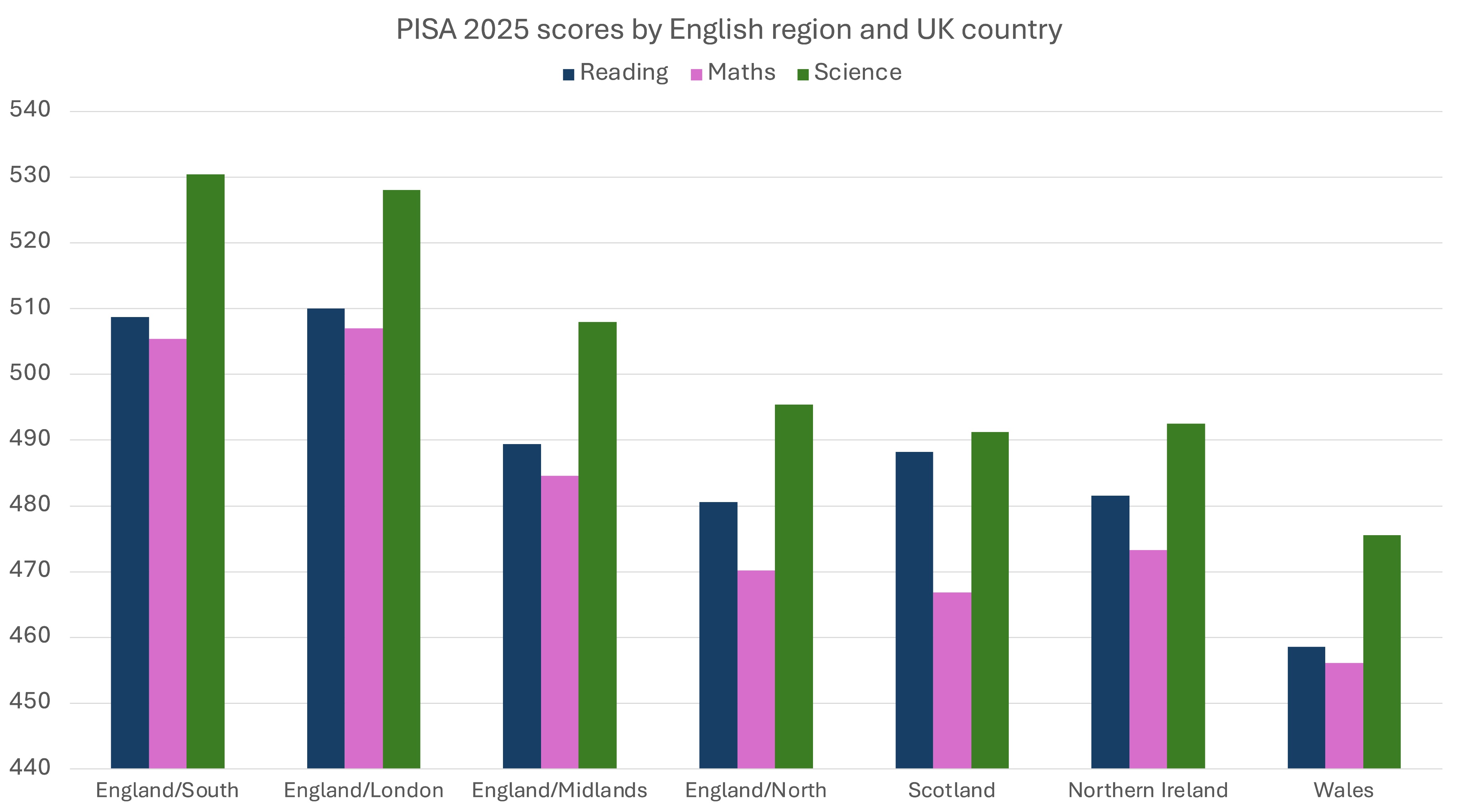

But look deeper and the English Midlands and the English North are achieving the almost unheard of feat of outperforming much more prosperous Scotland.
This is the clincher.
England’s education reforms have worked.
In my ideal world, local areas in England would have been free to choose their reforms. I hope they’d have mostly chosen what was instead imposed on them, but this is an unrealistic hope. The choices of Scotland, Wales, and Northern Ireland show that areas adopting what was imposed nationally would have been rare. The average result would almost certainly have been worse than what was achieved by removing local areas’ freedom to choose. Fewer English kids would have learned to read.
My Mum was a special educational needs teacher while we grew up. I, separately, spent a lot of my dinner times doing paired reading with those in my class who struggled. I am strongly positive about people being able to read.
But at some level of overachievement, outcomes have to trump process, even for a fan of process like me. I might keep quite a lot of the English education reforms of recent decades.
The world agrees and is desperate to emulate England. This is especially true of the European and North American nations and regions whose PISA scores have slid furthest downwards in an era of the internet, deindustrialisation, AI, smartphones, and constant distraction.
What England has done has worked. The reforms were done by multiple central governments, across all three major parties in England, in collaboration with experts, over more than three decades without a break. And they worked.
And now a new Labour government is going to undo a lot of them.
The world is rightly puzzled.
Why is the British government now undoing one of the few unquestionably great achievements of the last thirty years?
Daisy has promised to write up her best guesses and I look forward to reading them. I think they’ll be quite different to mine, because Daisy knows and cares so much more about the education system. But I hope some of my reasons will be important too and I’m sure they’ll be a bit different. So here are my three big reasons in reverse order of importance.
1/ Teachers and pupils are miserable and don’t own their success.
Teachers in the UK are not particularly poorly paid, nor are they enormously overworked. It’s a hard job, which people get paid fairly for, and for which they are held to account in alignment with that pay. But teachers I know in England don’t seem to feel much ownership of the success that they have achieved. They were told what to do, they did it, and it worked. I tell them that they’ve done well and they don’t seem to own that success. It was never really their choice, they just do what they’re told and they don’t really think they’re achieving all that well anyway, just helping kids be good at exams. That’s what my friends who are teachers tell me in the pub after football.
Teachers are pretty miserable at times. And in particular they notice that their pupils are miserable too. And they want something to change as a result.
Since education is devolved in Britain, Daisy has been able to collect together lots of evidence on pupil misery with similar pupils under different systems. It does not look like England’s school reforms that are causing pupil misery, since pupils in Scotland and Wales are just as miserable.
But I think we’re probably still going to change the education system because of this, because we don’t want to give kids more freedom to go outside and make friends, or take away their phones, or make them go to church, or shut down AI, or whatever other theory we currently have for why kids are miserable.
I think this is a bad reason for change, but I suspect it will be a powerful one. Daisy’s thoughts on this will be far better than mine, since she is so much better connected with the education system than me drinking 2 pints a week in a pub with a few teachers after football.
2/ Business involvement in further education.
Those English educationalists who are rightly proud of what has been achieved in the last four decades in English education will admit to some small problems. Shifting schools from local control to national control worked great. Universities are great (for now, until they run out of money as we restrict foreign student numbers) and well-attended. The massive expansion in higher education attendance achieved by taking polytechnics off local government and making them national worked well. Lots of people still go to further education colleges (although they could do with being funded better) and get apprenticeships or jobs with good training paths after 18 if they don’t go to university.
But no-one disputes that too many people fall through the cracks. Too few employers want to take apprentices, offer training themselves, or engage with colleges in training. Many say that this is because the education system is confusing and distant from them, a side effect of removing it from local control. The national education system seems to work great on international benchmarks, but employers still too often say that it doesn’t prepare kids for work, or connect closely with them to meet their needs, or help them contribute to society by training kids with support from local government that they have a relationship with.
I think this is a much stronger argument than the first. But I mostly agree with Sam Freedman (another fine blogger on education) that we could fix it with some return of power over education to local government without breaking nearly as much of the nationally-driven things that have been so successful in other areas. We should be able to get kids to read well, while engaging local tech companies to offer proper apprenticeships or other forms of training to local kids who choose to go to local colleges managed a bit more by local government.
3/ Better education failed to deliver its economic promise.
Which brings me to the best reason why I think we’re going to smash up our excellent education system.
It starts with Tony Blair in 1997 and his famous line that his three priorities for government would be “education, education, education,… because nothing matters more to the future prosperity of the country”.
Education was the priority. The promise was prosperity. And Blair was just expressing more clearly than others what a broad consensus in UK economics, policy, and politics believed.
For thirty years we built on the previous decade’s reforms and delivered on them. England probably now has the best education in the Western World all considered. And the promised prosperity has not arrived. There was growth of course under Thatcher and Blair, but this was before the outcome of education reforms could have had a big impact. As soon as the people leaving school and universities got better compared to their international peers, British growth stalled.
Wages have stalled, the graduate premium has fallen, much of our country has seen its economy weaken, and now the proportion of young people not in employment, education, or training is rising. Our country’s economy has fallen behind the EU’s, the economies of our large cities have fallen behind those of former communist East Germany, and the economists and educationalists who promised education as the key to a strong economy have no other answer than to keep proposing more of the same.
Most awkwardly for the Blair argument, it is the part of Britain that has done worst on education, and whose policies on schools and universities have been most frequently attacked by policy makers, journalists, and education experts in England, that has done best on growth. Scotland’s growth in output per person has just about kept up with the USA and the EU since devolution, while the rest of the UK and especially England outside of London have fallen ever further behind.
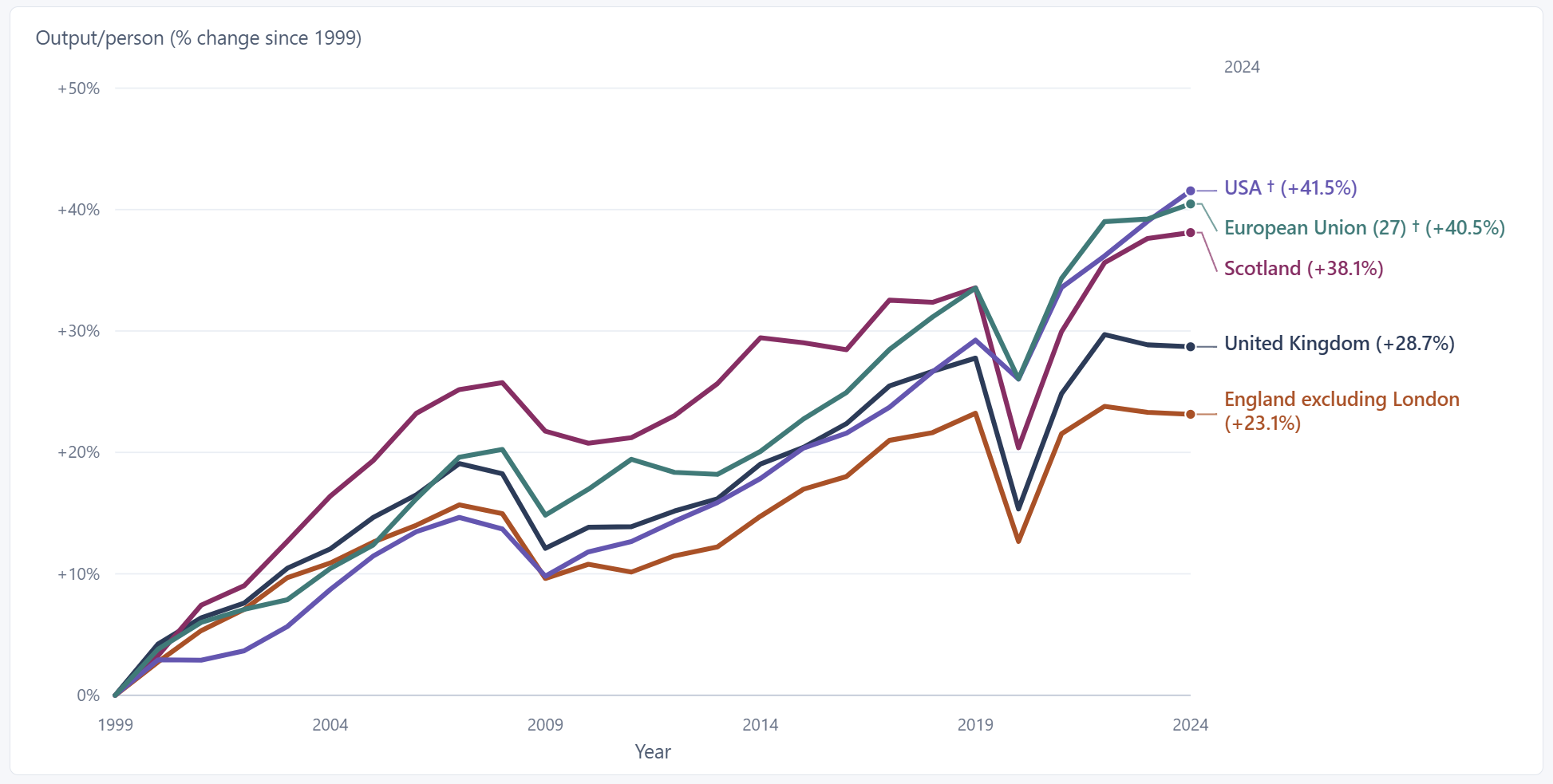
Scots may struggle more to read the graphs than their North English neighbours, but they can at least afford the Financial Times subscriptions needed to access them.
Increasingly I experience a well-intentioned form of gaslighting from those who deny, or seem unaware, that Blair’s clear words reflected a British near-consensus that skills were the biggest determinant of prosperity and education the best way to generate them. I was in the rooms and even at times part of the discussions where investment in much else of what could contribute to a strong economy was sidelined and cancelled so that the focus could be brought back to the education reforms that have delivered great exam results and little prosperity. My views were so unusual that I developed something of a reputation as a skills-denier and a transport supremacist despite having always argued for transport, R&D, and devolution together.
When Daisy writes that “I would politely suggest that rather than getting primary schools to develop NEET strategies, the better public policy option is for the government to develop a growth strategy” and John Burn-Murdoch writes that “Like so many of contemporary Britain’s problems, the graduate squeeze is downstream of broader economic woes. Efforts to alleviate it would do better to focus on restoring growth than making tweaks to higher education” I think that they are missing the point a bit. (Daisy and I agree more than I am suggesting here).
Education was the growth policy.
And even though it has failed, it remains the growth policy for far too many in our capital. My view, and that of quite a few others outside South East England most strongly arguing for change, is that we will not achieve the growth we want without sacrificing much of what we have achieved in education.
We are more likely to get the much higher economic growth rates correlated with devolution in Britain if we do devolution, including in education. The record of devolution at achieving good school education outcomes is extremely poor.
We are more likely to get the stronger economies and the stronger innovation systems that we see in Finland and the Basque Country if we undo most of Thatcher’s reforms to universities and re-establish strong links between research and industry with strong local and regional government mediation. This will weaken our most famous universities. As I put it in a question at the recent Industrial Strategy Advisory Council meeting, we will have to sacrifice Nobel Prizes for the chance of industrial success.
We are more likely to get strong economic growth by better including more of the half of young people who don’t go to university and the companies that should be employing them in that growth. And I see no way that the employers can be brought back into our education system except with the kind of branding, gimmicks, and genuine engagement that Andy Burnham was working on in Greater Manchester and now hopes to extend nationally. This will fragment our education system and reduce the accountability and choice that has worked so well to boost outcomes.
These are sadly quite substantially zero-sum games. Politicians will have to lie and say there are no trade-offs, but there are. We can see the mechanisms and the examples from abroad of how a push for growth is going to weaken our education outcomes. We should do them anyway.
That’s the context in which I suspect the world will look at us in England like we’re mad. North Englanders like me will tear up what looks from the outside like our greatest success. And the politicians won’t be able to say why they’re doing it. But I can. I just did.