Agglomeration beyond London.
, .
I found much to agree with in Daniel Susskind’s FT opinion piece on how Burnham must learn from Starmer’s failures on UK growth.
As he details, the actions of the Starmer government do not suggest that growth was prioritised as highly as was suggested by its position at the top of the manifesto’s five missions. We agree that after two decades of national economic stagnation it deserved to have been, and that Andy Burnham’s reference to “good growth” and “growth in every postcode” are not good signs that it will be this time.
We agree even further that technological progress is of critical importance in achieving growth, that AI is almost certain to be a critical such technology, and that moral scepticism of companies such as Palantir that might apply it well in our public services is a luxury opinion we should be cautious of holding too strongly. There are many within the NHS and its domestic supply chains who are sceptical of the quality of Palantir’s work and their claims and it is their voices that should carry weight when making decisions about how much to use their services.
But a blog post only of agreements would be of little value.
My three disagreements, all in the direction of optimism, might add more value. And even though my economic views are to the right of Andy Burnham’s, they may help others understand why some of his views from North England differ from theirs.
Devolution.
I am more positive about the effects of devolution on growth than Daniel. While I agree that “the evidence that devolution drives growth is weak”, this is true of most claims in economics.
Many of us working in regional growth have long joked that the What Works Centre for Local Economic Growth at LSE should have been called the Nothing Works Centre for Local Economic Growth given how often their reports largely fail to disprove the null hypothesis.
This is mostly not because they do a bad job of looking, though I think they often set the bar too high for the standard of evidence they accept. It is more because strong evidence is hard to find in economics. It is a field with huge numbers of interacting effects, most of which are not measured, and where controlled experiments are frowned upon by ethicists and voters alike.
As an example of how frustrating economics is, the huge amount of work that has been done tracking the impact of Brexit on the economy of the whole of the UK has taken a decade to disprove the null hypothesis that Brexit made no difference. We can still only do so just barely, with reasonable estimates of the negative impact on GDP/capita growth between 1% and 10%. It would be surprising in this context if the much smaller impact of devolution, among much larger confounding variables, measured using worse data, for much smaller economies, could generate evidence that was any stronger than “weak”.
In an excellent demonstration of AI’s potential to increase productivity by some measures, the papers cited to back up claims that the evidence that devolution drives growth is weak, particularly for the UK, are two of the top three that ChatGPT suggests if you ask it. Here are the top three papers that it suggests if you ask it to show the opposite.
Armed with papers on both sides, it remains the role of humans to take a position. Here is mine on devolution.
In 1998 and 1999, Scotland, Northern Ireland, London, and Wales all voted yes in devolution referendums, with new or restored devolved assemblies and parliaments receiving their powers in 1999 or early 2000.
Since then, the inflation-adjusted GVA/capita (the least bad measure of regional economic strength we have) of every one of these regions has outgrown the rest of the UK.
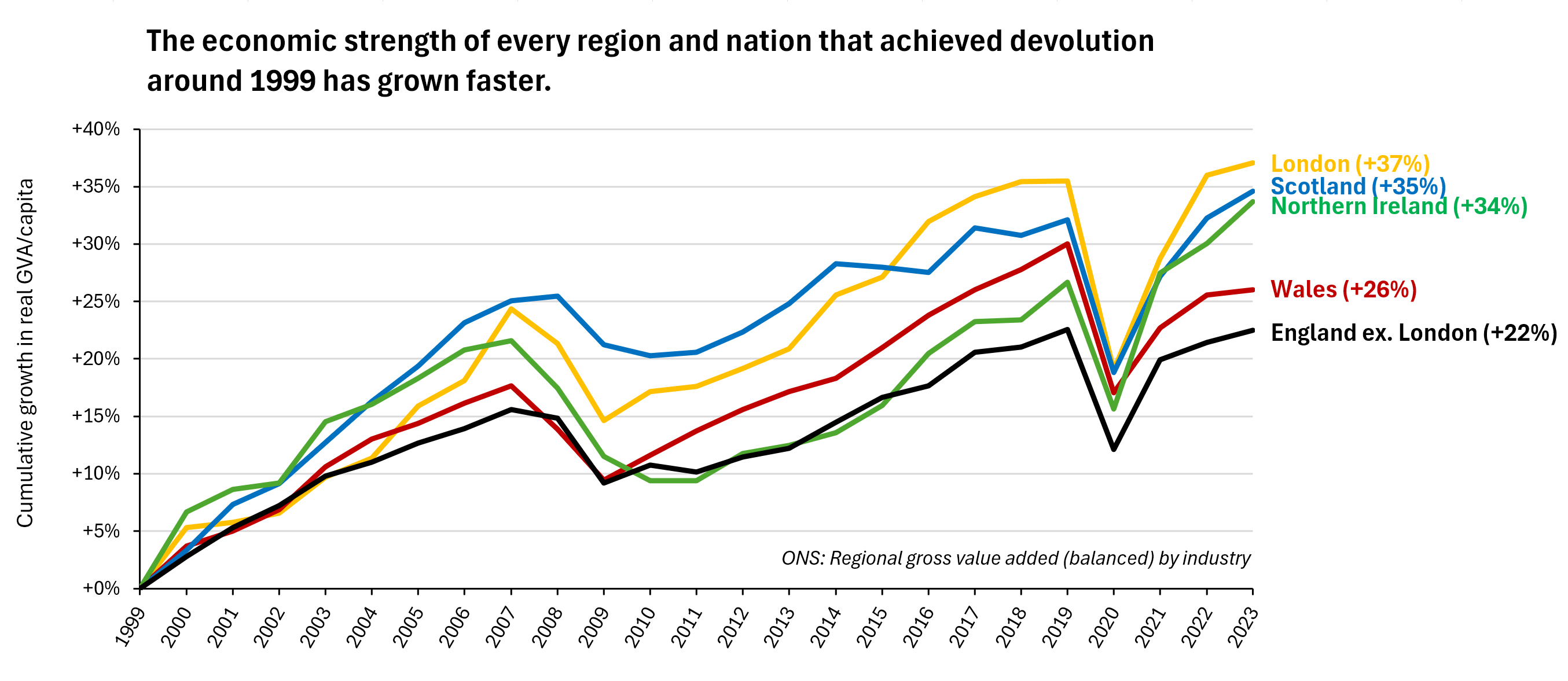
From the modest overperformance of Wales of just 4 percentage points, to the big overperformance of Northern Ireland, Scotland, and London of between 12 and 15 percentage points, this is evidence that devolution drives growth. It remains weak evidence — there are too many other factors at play, the measurements are inaccurate at small geographies, boundary effects and changing commuting patterns (especially around London) cause distortions, and controls on demographics, sectoral mix, historic trends, and much more have not been carried out.
I have done many of these controls using synthetic control methods like those used to estimate the cost of Brexit to the UK and my best guess of Scotland’s overperformance with this method halves to just 6 percentage points. But I have also shown that this result is not statistically significant.
So yes, the evidence that devolution drives growth is weak. But it is not that weak.
If it had gone the other way, I am certain that my side of the debate would not be allowed to ignore the data as so many sceptics of devolution’s economic impacts do today.
The data is certainly incompatible with claims such as those by David Gauke that “It is very hard, for example, to make the case that devolution to Scotland and Wales – including substantial fiscal devolution – has had a transformative positive impact on the economies of those nations”. We are discussing effect sizes of between one and three Brexits. These are big numbers, even if uncertain. The case is easy to make.
It is hugely frustrating that views like his are so common and so ignorant and seemingly uninterested in the basic data of the argument. It means that we cannot progress to the more interesting and fruitful discussions we need to return to prosperity as a country.
Overheating and competition.
Andy Burnham has referred to London’s economy as overheating on many occasions. I agree with him and I think it is a bad thing.
London’s main airport operates well beyond the design capacity of its two runways, which its Mayors promise not to expand. Its population’s housing needs far exceed the capacity of its housing stock, whose growth its Mayors constrain with promises to protect the greenbelt and huge levies on new housing dressed up as affordable home requirements. Its population via their local governments force the pubs to close early. Companies that wish to expand struggle to find office and lab space. Peak time trains into the city are overcrowded and the existing railways have little capacity to run more or longer of them.
And into this economy, the UK government injects ever more economic stimulus. In my areas of expertise, ARIA, a new research body has been placed in London, as has the National Data Library. I think both would have delivered better outcomes somewhere else, but the consideration was dismissed without serious thought.
This has gone on far longer than I have been alive. But just in that life, and just in my areas of expertise, I have seen The British Library, The Crick Institute, The Open Data Institute, The Alan Turing Institute, The Digital Catapult, and more big UK government national investments stimulate the economy of a city that cannot house its people well or provide the space that its companies need to grow as fast as they would like. And with that stimulus, the government has stimulated growth in London partly by relocating existing economic strengths, and displacing future growth, from the large cities further North where I have lived and worked.
What should we call this except overheating? If there’s a better word, I’ll happily use it. But I don’t think there is. The disagreement I suspect is on how this should be tackled.
For many, like Martin Wolf in the FT, it is unimaginable that serious growth in Britain could happen elsewhere. Agglomeration matters, he argues, as does Daniel in his piece. And yes, it does. But Britain has many large agglomerations. Leeds has the scale of Stockholm or Copenhagen. Manchester the scale of Munich. Liverpool the scale of Dublin. Birmingham the scale of Hamburg. Sheffield the scale of Marseille. And Newcastle the scale of Turin. And because these cities except for Newcastle are so close together, it can easily be argued that England should contain both Europe’s largest and third largest agglomeration in terms of population, both of around 20 million people within 100km of London and Manchester respectively.
And yet Britain’s large cities, with the exception of London, trail well behind their European equivalents. Fixing this would grow the UK economy by 7% to 14% depending on whether we could emulate French or Nordic and Dutch economic city performance. And we know from East Germany, however troubled their reunification has been, that it can be done, because the economic strength of their cities have all now overtaken their North English equivalents.
“If you really care about growth, you should want the capital to be firing on all cylinders, not trying to cool it down” argues Susskind, and I agree.
But I do not believe that locating ARIA in Manchester, as I argued for, or the National Data Library in Leeds, as I argued for, instead of in London by lazy default would be “holding back London” any more than putting both in London held back Manchester and Leeds. It might, I concede, cool down London in the short term by transferring a fixed amount of public sector stimulus to big cities with much more capacity to amplify it into private sector investment and prosperity. This would be good for national growth in the short term and importantly I do not think that it would cool down London in the medium term.
London, Oxford, and Cambridge act like spoiled brats within Britain because they know that their proximity to power and the privileges that buys will get them public investment even if they oppose permitting growth locally and overheat their economy by doing so. A central planner would intervene and force them to grow. A deeper believer in a market of places like me would take the more American and European path of giving places the freedom to compete and using public money to back the places that permit growth and choose to win. I bet London, Oxford, and Cambridge would soon find their appetite for growth once they saw public money historically reserved for them was going elsewhere.
Investment and agglomeration.
The success of Salford Quays, from the early move of the BBC to now a thriving and dense centre of economic activity in Greater Manchester, is one of many proofs that transferring public sector stimulus can work. Spillovers are visible everywhere, with my favourite example being Warrington company BetFred’s TV Studio at Salford Quays delivering extremely profitable innovation on top of a local industrial strength thanks to a state-backed cluster.
I expect similar success from the operations of Number 10 North if they are placed in central Manchester as proposed and not in a small town where they are designed to fail.
And I expect success because while not mentioned in Daniel’s short piece, I believe that it was state investment that was at the start and the heart of the Kings Cross AI cluster. The thick networks of researchers, entrepreneurs and investors that he mentions came together substantially because the UK government provided fantastic connectivity with huge investments in Thameslink, HS1, St. Pancras Station, and The Elizabeth Line nearby. And because the UK government directly created employment for researchers and meeting places for entrepreneurs and investors at the site by placing large national institutions there and funding them generously.
Richard Jones and I have shown that public sector R&D funding has for decades been far higher in London than private sector spending merited. We predicted that this would crowd in precisely the ecosystem that we see in Kings Cross. Londonmaxxing is the proof that this has happened.
As I mentioned at the beginning of this piece, I disagree with Andy Burnham that we can have good growth in every postcode. Agglomeration is likely to remain an important factor in achieving growth even in an age of AI. But the UK has more than a single agglomeration on which it must pin its hopes for growth.
There are at least seven places outside of London with the scale to prosper. A combination of better government spending — targeting maximal growth instead of a regional preference towards South East England — and devolution — freeing places up to raise or lower taxes and invest or cut for growth — stands an excellent chance of succeeding as it has elsewhere.
Our current ongoing failure to do this is a huge lost opportunity both directly in our hugely lagging second cities, and indirectly because of the complacent opposition to growth that it generates in London and the Greater South East. And on that, I suspect Andy, I, and many more Britons in and around the really big cities outside of South East England agree much more.