Taxing for Growth
, .
In Northern Europe, Britain has eight big neighbours. Ireland, France, Belgium, the Netherlands, Germany, Denmark, Sweden, and Norway.
Of these, Britain’s economy is the weakest.
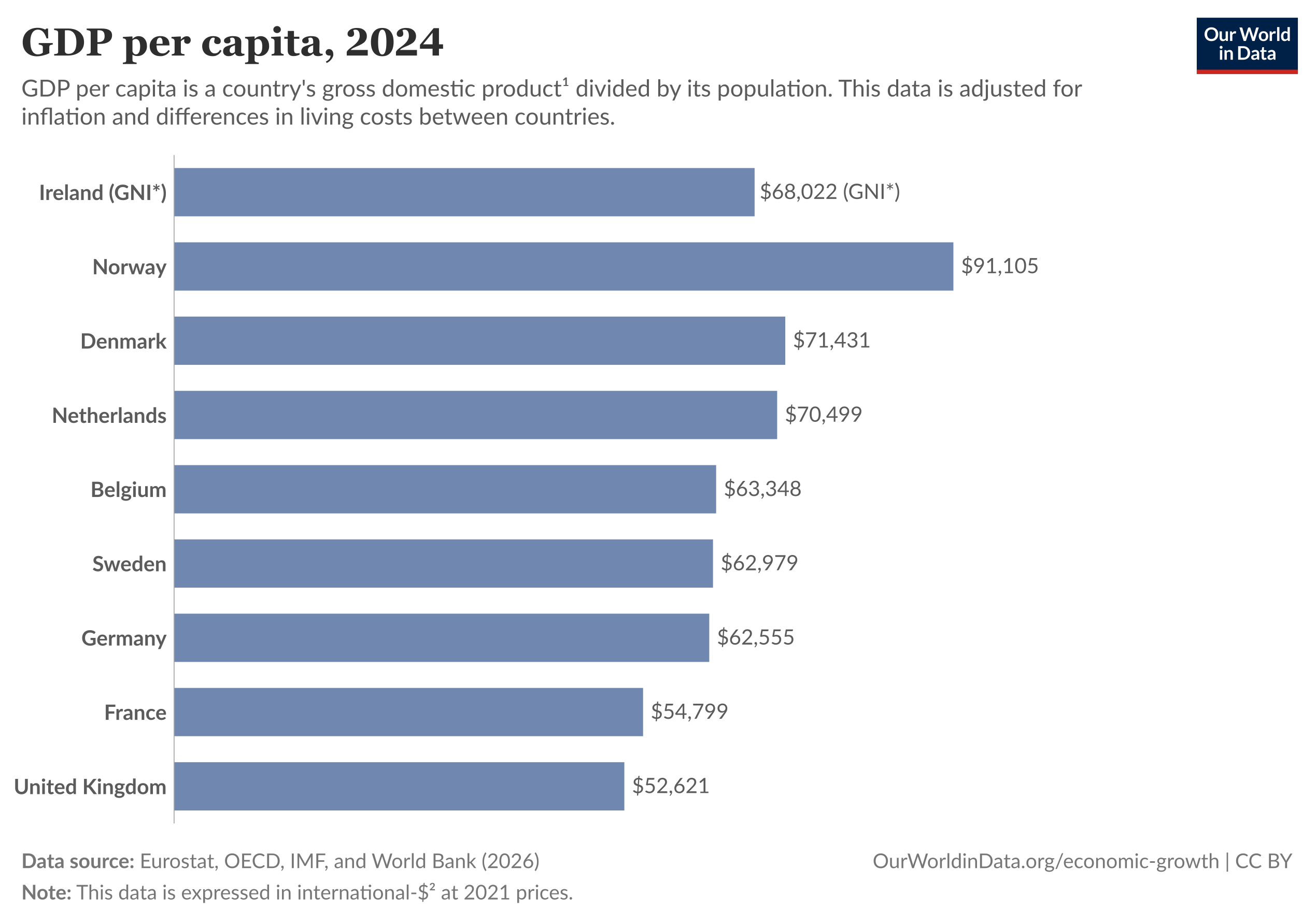
Against France it’s arguable. It depends on the year and the purchasing power parity or the exchange rate between the € and the £. But against the others it’s not even close. And yes, that’s even after you adjust Ireland’s economic strength for the fact its GDP figures are nonsense by using the GNI* method explained very well by the CSO.
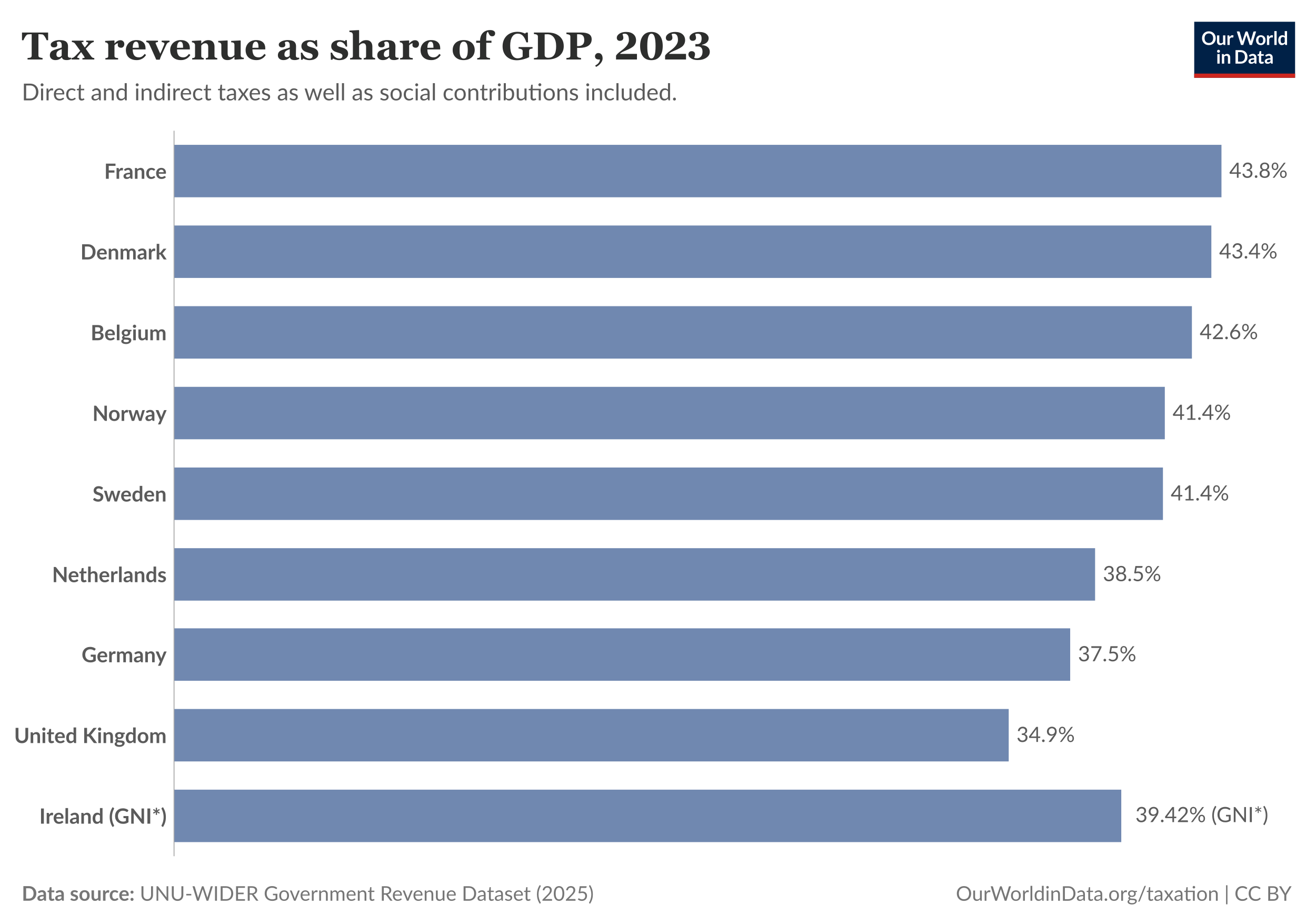
From another dataset (this time from the UN, but the OECD gives the same answer) we can show that taxes as a percentage of GDP (again, using the GNI* figure for Ireland) are lowest by some margin in Britain.
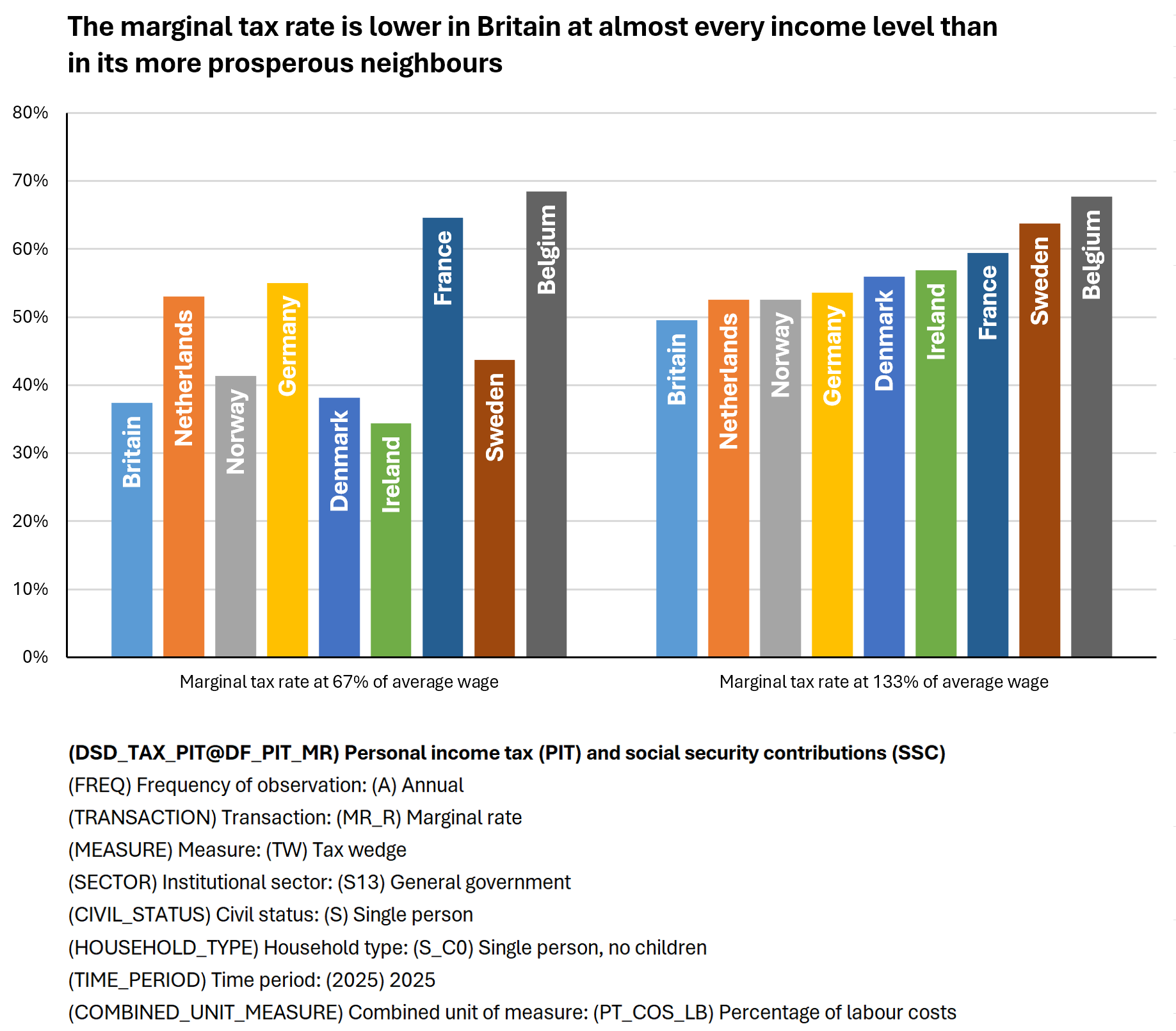
And from yet another OECD dataset we can show that the marginal tax rate or the tax wedge (both show the same thing, pick your measure) at both low and high wages, and at almost all wages, is lower in Britain than in its neighbours.
Of course I could pick other countries and not just our nearest neighbours.
The USA and Switzerland have lower taxes and much stronger economies and we could have lots of interesting discussions about why that is. Do low taxes in themselves boost growth? Or is it the highly federal government structures and heavy fiscal decentralisation that achieve that? I’m sure they interact, because everything in economics does.
We might even have chance to talk about whether governments should run big budget surpluses or deficits and how to achieve tax competition within and between countries without inefficient distortions. Maybe we’d get on to how, if Britain does raise taxes, we avoid spending it all on education and health which don’t seem to boost growth much and instead invest the money that raises or lets us borrow in better infrastructure and scientific research, which has a much better record.
I find those discussions more interesting than ones with the British left who insist income inequality has risen even when it hasn’t, that building more homes won’t make them more affordable, that money can be printed safely without limit, and that taxing wealth from the centre is more likely than taxing income locally, including on lower middle earners, to generate the investment I agree we need to enable economic growth.
But the better conversations are much harder to come by when so much of the British right seems unaware that Britain’s taxes have long been, and remain, low compared to our much more prosperous neighbours and sneer at reasonable proposals for greater “taxing for growth”.