Entrepreneurial Britain
, .
I recently spent a fantastic day in Manchester with Mike Emmerich of MetroDynamics and a broad spectrum of pro-growth Brits. We were searching for lessons to learn from a city that has escaped from economic decline in recent decades.
Manchester is a standout performer in England, though we must keep in mind that it remains among the less productive of its peers in North Europe and North America. Mike and his team, among a great many others, deserve huge credit for their part in that transition and their ongoing work to help Manchester escape the bottom half of the rankings.
The conversation was one of many happening more frequently and more urgently in Britain in recent years. Against the backdrop of two decades of economic stagnation, and increasing despair at the prospect of a third, setups like The Centre for British Progress, TxP, and Works in Progress are hoping to return Britain to the forefront of human progress. We share a hope that Britain will return to being among the most prosperous big countries in the world.
During discussions before I snuck off for a few pints with friends, and to watch Leeds United beat Manchester United, we touched on how we could get more people in more parts of Britain to have the ambition that’s needed to grow our economy and contribute to that success. One suggestion was that we needed to inspire and help people in more places to be more entrepreneurial.
I agree. We should do more to invite, inspire, and enable people to start businesses. I’ve started and helped start a few businesses myself and I have few regrets. But in the discussion I was reminded of one of my favourite bits of data on entrepreneurialism in Britain. Knowing about it can help us set an even better goal, so I’m sharing it here.
Good news
We start with a good news story. In a country where so many economic indicators vary hugely across our country, entrepreneurialism is well distributed. Post-industrial Middlesbrough has the same business start-up rate as hip and innovative Stroud. Faded seaside glory Blackpool has the same business start-up rate as technically cutting-edge Worcester. Former leather tanning town Walsall has the same business start-up rate as supposedly overheating Bristol.
You can reproduce that data by downloading the ONS Business Demography dataset’s business birth rates in 2024 table and joining it with the 2024 local authority population estimates for England and Wales, and equivalents for Scotland and Northern Ireland. And that is where the story gets more interesting.
To tell that story I’ll focus on four local authorities with similar populations — Bradford, Leeds, Cambridgeshire, and Oxfordshire.
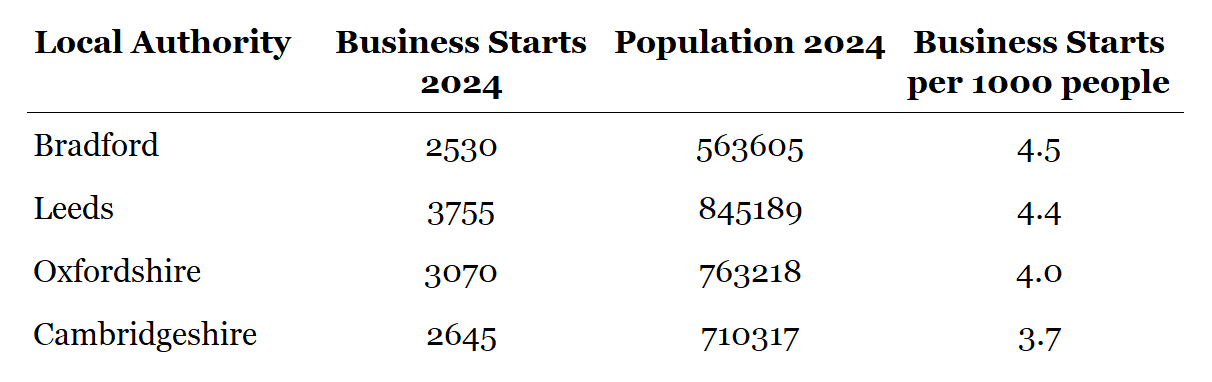
Bradford is the most entrepreneurial of the four. Cambridgeshire is the least. And just in case you think I’ve cherry picked Cambridgeshire instead of Cambridge, the business startup rate in the tightly bounded city of Cambridge is the same 3.7 at the bottom of the list.
Long-time readers of my blog might fear another anti-Cambridge rant is on its way. I promise I won’t do that.
What kind of startups.
The ONS data stops here. For further analysis we turn to data from The Data City, a company in Leeds I co-founded in 2017. What follows is a very small amount of the data we have, and of course I’d like to sell you a subscription to access it all and ask your own questions. But for now I’ll just give you some selected answers.
The first thing we can do is look at the SIC sections of the companies founded since 2015 that still trade in the four local authorities. Because all four have similar populations, we’ll just compare absolute numbers of startups, not startup rates.
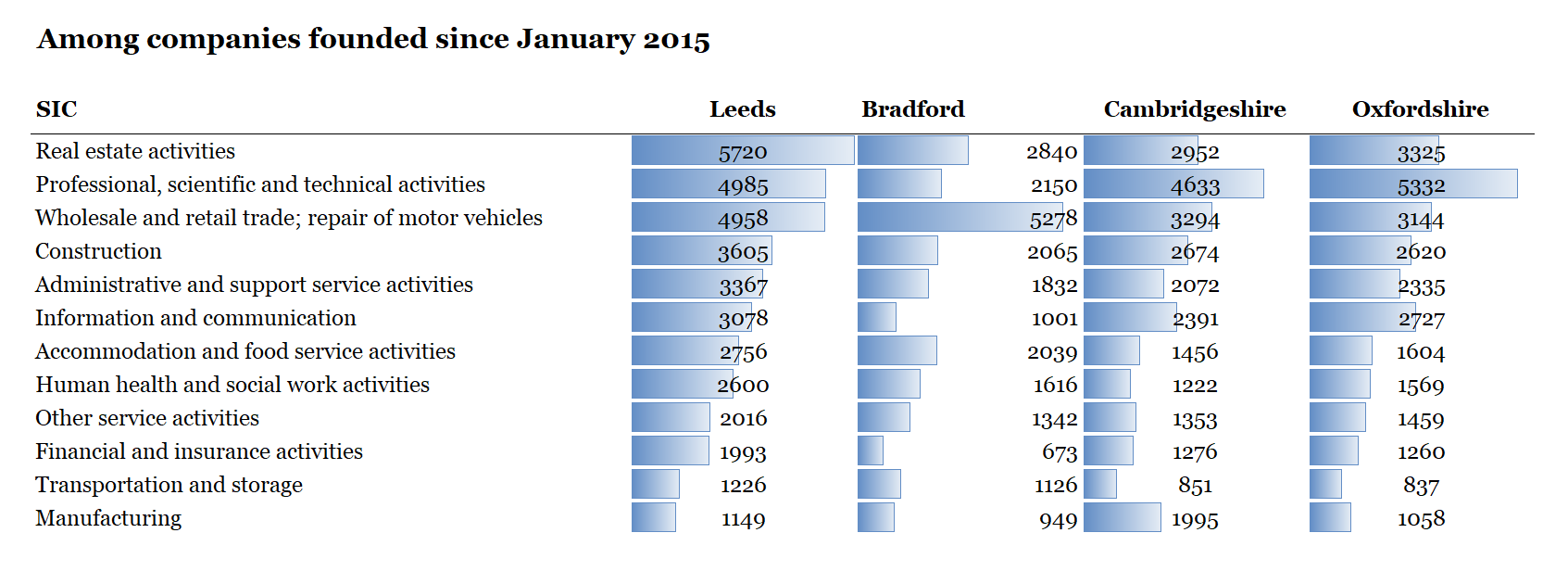
We see that Leeds has a big real estate specialism — no surprise for a city currently building homes at a record rate.
Bradford’s specialism is in wholesale and retail trade and the repair of cars. I can vouch that if you need some spare parts for an old Vauxhall Corsa finding and fitting at a reasonable price, Bradford is a great place to be. Fine place for a curry and a few pints afterwards too.
What Bradford lacks quite notably is new businesses in professional, scientific and technical activities and in information and communication.
That Cambridge has twice the rate of startups in manufacturing than the other three places is interesting.
What companies really do.
At this point, we reach the limit of what we can do with ONS data and the standard industrial classification (SIC) system that it relies on to classify company activities.
At The Data City we replace the SIC system with the real-time industrial classification (RTIC) system that we’ve built over the past decade. The classifications are based on the website text of millions of companies and training sets of hundreds of companies we manually select in partnership with sector experts. We have the websites of every company in Britain, Ireland, the USA, Germany, and France and the ability to classify any company into 400 RTICs instantly.
At the simplest level, this website text shows us which words are most overrepresented on the websites of startups with a website (companies in Bradford are much less likely to have a website) in our four places.
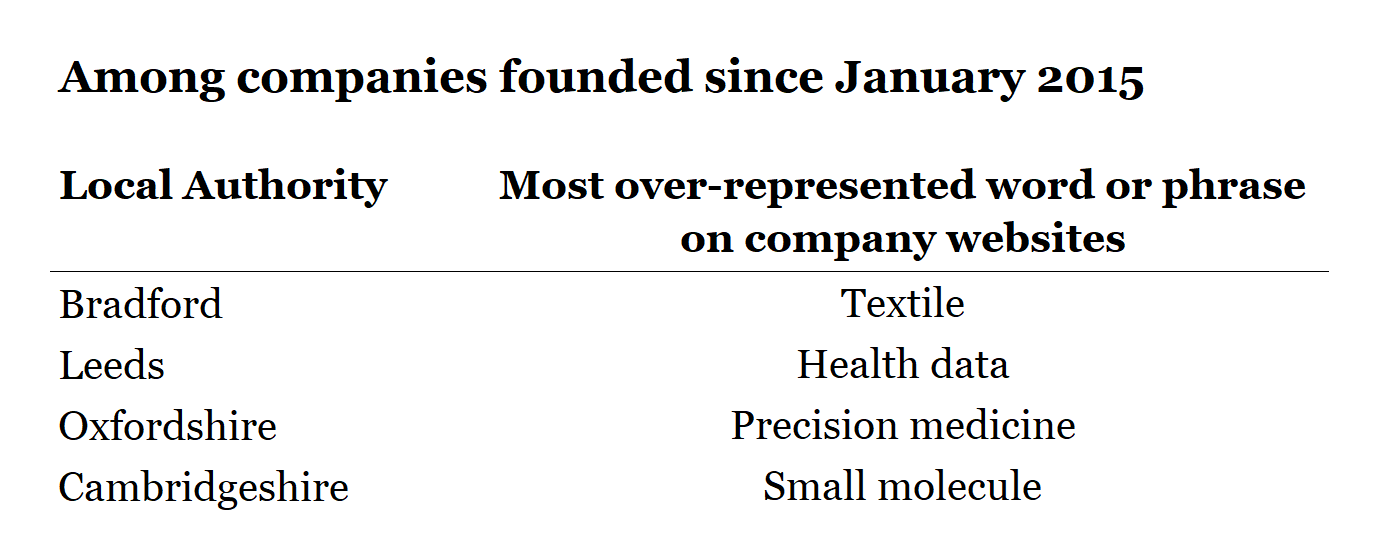
We see that Bradford’s history as one of the world’s hubs of textile production and trading lives on. Indeed many of its wholesale and retail trade startups are related to wool and other textiles to this day.
Leeds has a clear focus on health data and data more generally while Oxford and Cambridge go even further along the value chain in health.
Membership of any RTIC (companies can be members of many) typically means that a company is operating in a sector at the frontier of the economy. Looking at a selection of fifteen interesting RTIC sectors, we see even more interesting patterns.
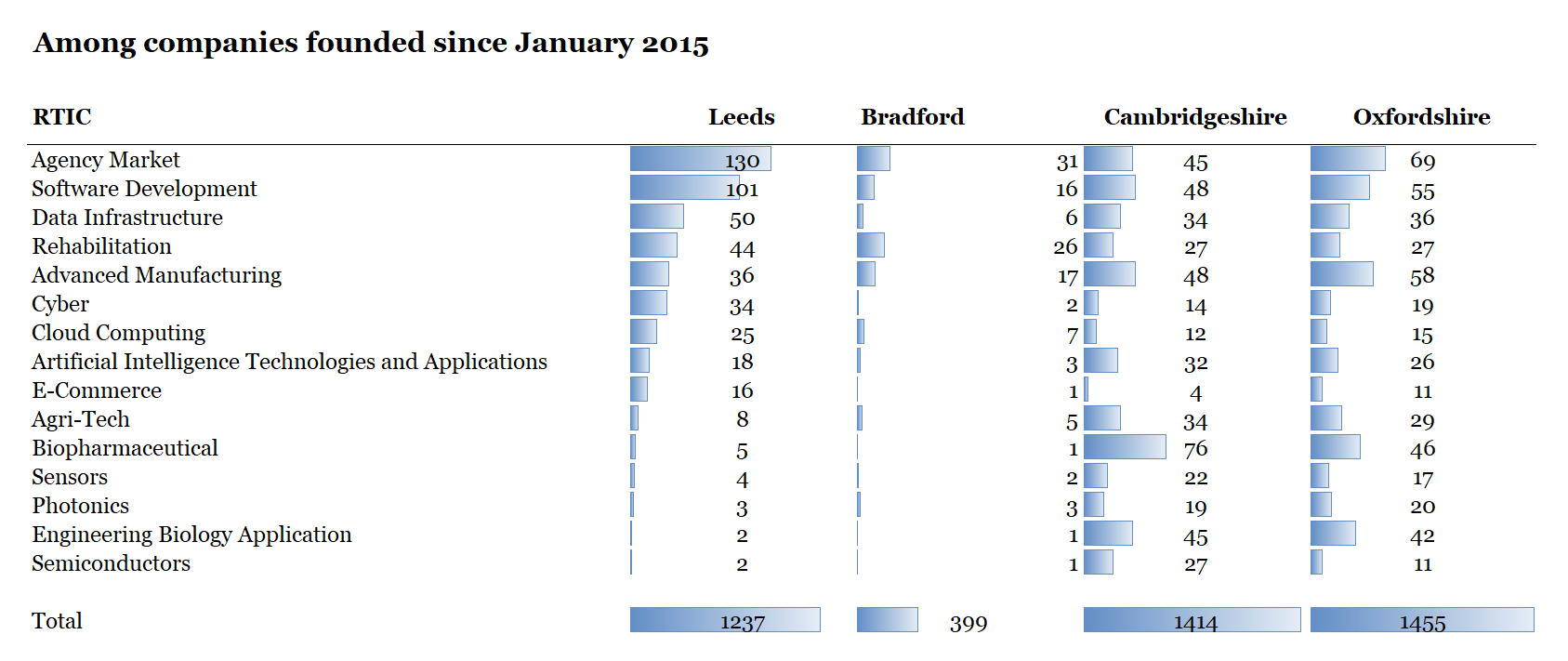
We see instantly that Bradford has many fewer firms in RTICs. We can see a hint of some strengths in rehabilitation and in some areas of advanced manufacturing, but just a hint.
For Leeds, the strengths are much more obvious. In the agency market — a sector best defined by Leeds startup Agency by Agency — it is well out in front, as it is in software development and data infrastructure, cyber security, and cloud computing.
While in Oxford and Cambridge, deeper advantages in narrower fields such as Biopharmaceuticals, Engineering Biology, Sensors, and Semiconductors are just a few strengths of many.
Startups and startups.
It is this difference in the type of startups between the four places we’ve looked at that can make it feel counterintuitive to describe Bradford as more of a startup hub than Cambridge, especially when we see the impact in terms of money of these different specialisations.
At The Data City we join in dozens of datasets to our database of companies. Two are Innovate UK Grants awarded to companies, and VC-related funding via Dealroom. And that shows a huge gulf between Leeds and Bradford, and Oxford and Cambridge.
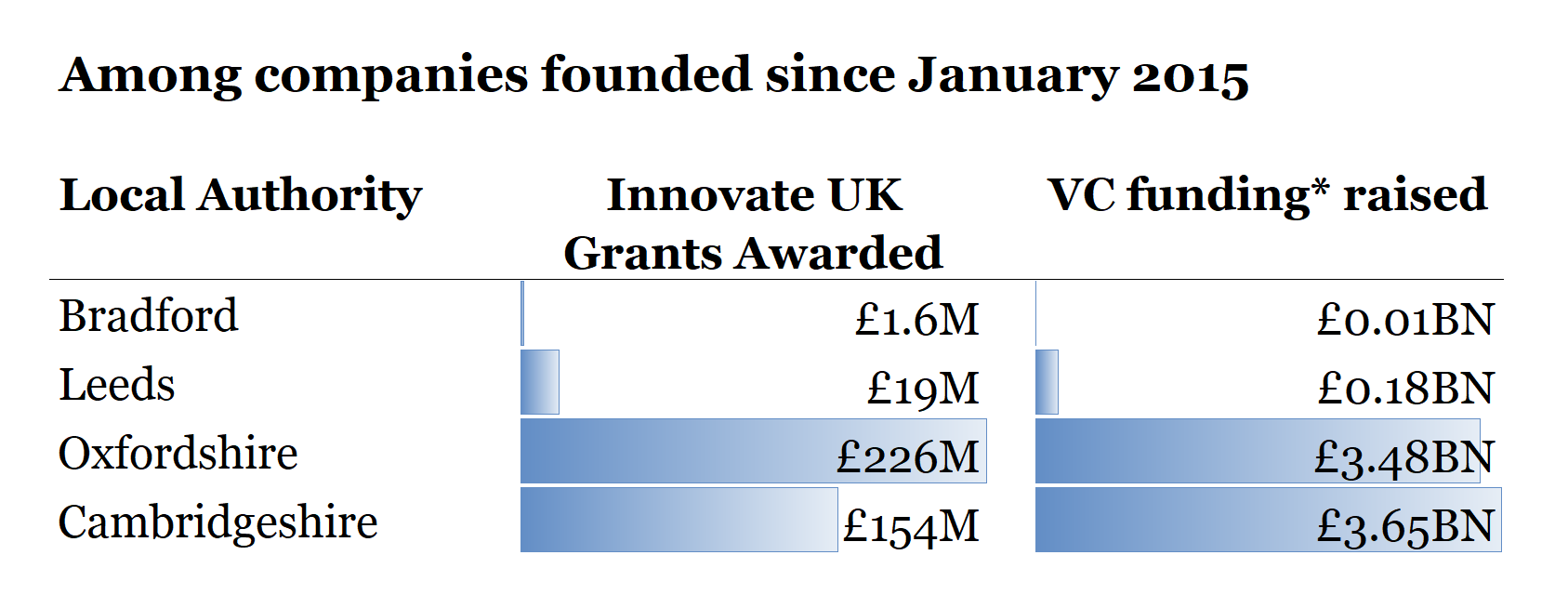
It is very fortunate for Britain that while regional economic inequalities are so high by many measures, entrepreneurialism isn’t one of them. We have ambitious people everywhere willing to take a risk, set up a business, and try to succeed.
We may want to encourage even more people to do this of course. But even more important is to inspire and help people to start more of those businesses in sectors closer to the economic frontier.
And here we have even more great news. All four places have the kind of businesses we should want more of and which we should want to grow faster. Companies like Bradford’s Sentristream, Leeds’ Hippo Digital, Oxford’s OMass Therapeutics, and Cambridge’s Bicycle Therapeutics. And I hope companies like mine at The Data City, who you can buy all this data and much more from.