Building things in Britain is unusually expensive.
, (approx.).
Building things in Britain is unusually expensive. This seems to be especially true of railways, trams, airports, and motorways.
You might come to this conclusion in a few ways.
You could see that a basic new station on an existing railway line in Leeds now costs £16m and think “that’s a lot!”. You could talk to some people involved in building things in Britain and listen to them say “yes, it costs a lot”. Or you could read the write-up of a report by British think tank Britain Remade in The Financial Times which shows that show building and upgrading railways, trams, and motorways in Britain typically costs twice as much as in France.
Our low past investment in these things and our rapidly growing population makes this particularly unfortunate.
Two obvious questions follow.
Why are the costs so damn high?
Why do things cost more to build in Britain?
And.
How could we build things more cheaply here?
A decent place to start would be to look at the comparable country with the lowest cost of building in Britain Remade’s analysis. France.
There are a lot of ideas in that report and elsewhere. People say that Britain does too little planning and so can’t make sure that there’s a continual stream of work that people can gain experience doing and do more efficiently as they go on. Other people say that Britian does too much planning, meaning that most of the money on projects is spent clearing environmental or political planning hoops. Some people say that Britain does too much future-proofing and gold-plating, making sure that new or upgraded infrastructure can handle more people, more trains, more lorries than we can reasonably expect. Other people say that Britain spends too little on those things and then has to pay twice when it is inevitably forced into upgrades later on.
And of course everyone thinks that the reason for higher costs in Britain isn’t simple. It’s a combination of lots of different factors that all interact in complicated ways.
One of those factors might be the British approach to safety. Britain has just about the safest railways and roads in Europe. This is a good thing. Thousands of Britons are alive today that otherwise wouldn’t be. But it’s also a bad thing in some ways, if it pushes up the cost of building things so much that we use more dangerous modes of transportation, like driving, instead of safer modes of transportation, like taking a train.
I dared to make that last point online a few months ago. And I’ve received a bafflingly large and diverse amount of hate for it. So I decided to check if I was being unfair.
Some elements of rail safety in France vs. Britain.
I’ve lived, worked, and gone on holiday in France. And sometimes I take pictures. So I’ve got a picture of the platform at the well-used Nice-Riquier station that a large crowd of commuters are walking on while it is under construction.
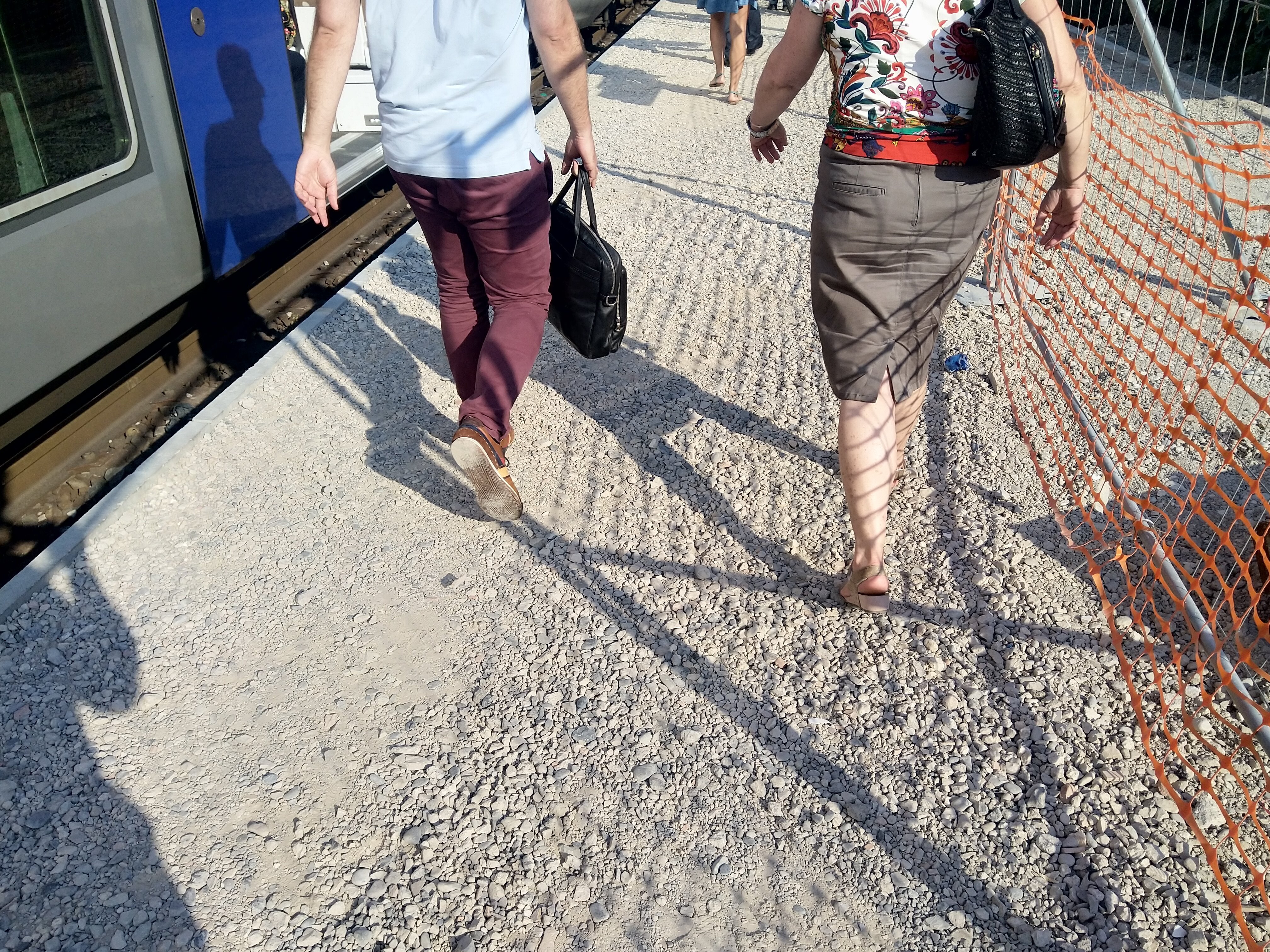
No yellow line, no tactile platform edge, and uneven gravel at a non-standard height.
Just off camera are workers with power tools working on the platform behind a thin plastic fence.
Does this happen in Britain? I can’t prove that it never does, but I’ve never seen it. I have shown the picture to people who work on Britain’s railways and listened to them say things like “that really shouldn’t be happening” and “I don’t think that would happen here”. But I can’t ask everyone.
I’ve also noticed both when I’ve visited, and on Google Streetview, that in France, Italy, Sweden, and even the Netherlands, railways, even quite major lines, are often left unfenced.
I’ve had rail industry people confirm to me that this is a feature of railways in Great Britain. Penalties for leaving a railway inadequately fenced here are apparently unusually high. But I’ve never verified what I was told with data or an analysis of the laws of a set of countries.
What about something measurable?
I’ve got pictures from major stations in France and Italy where large groups of people are walking across the tracks, with luggage, on busy railways, to get to and from trains while other trains in the station are moving.
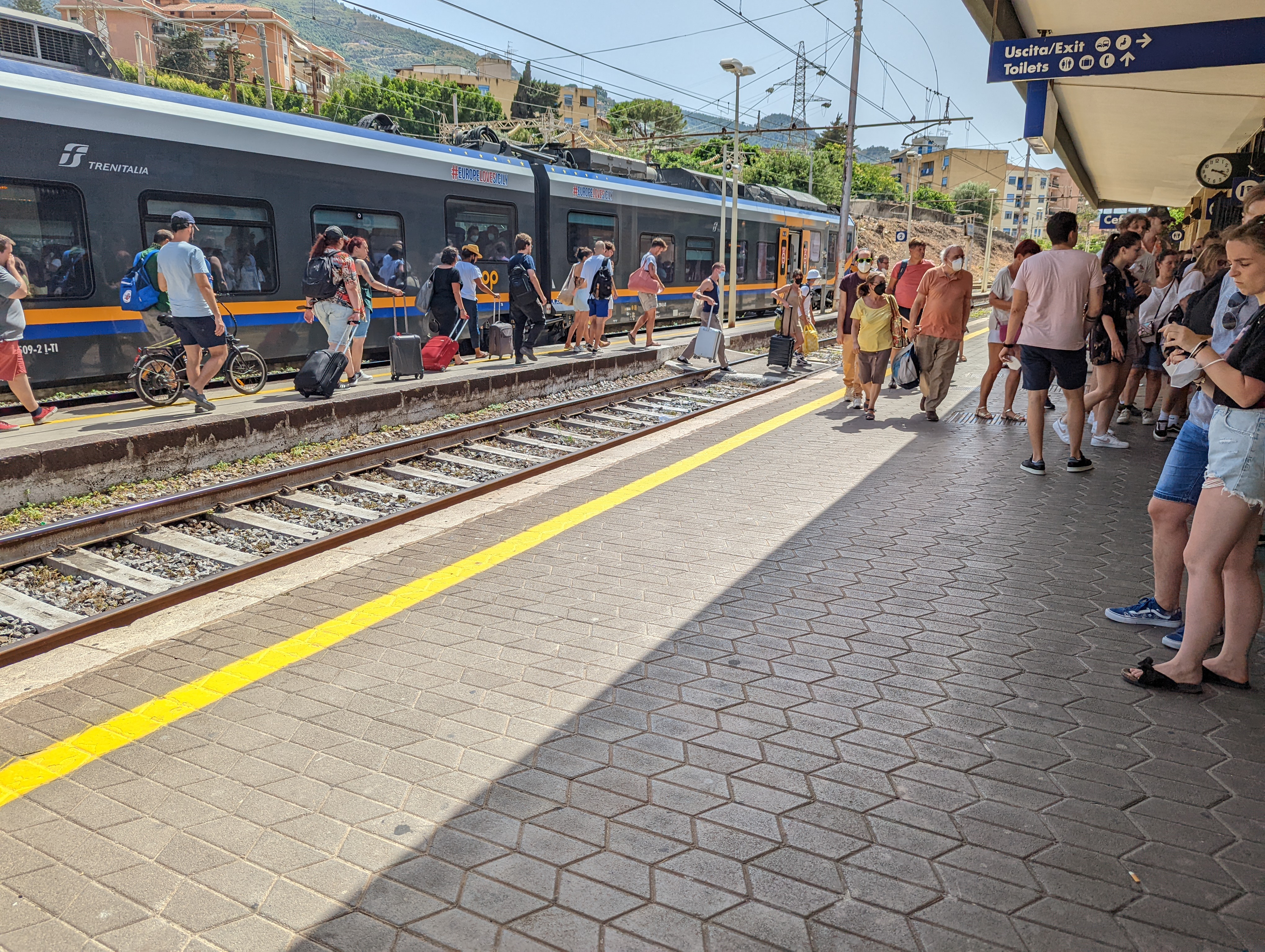
This is rare in Britain. Or at least, I think it is. We’re in the same situation as the other two examples. I see this much less in Britain. I’ve talked to people who work on the railways in France and Britain and they say that it’s much less common in Britain. But I haven’t checked the detail of the data.
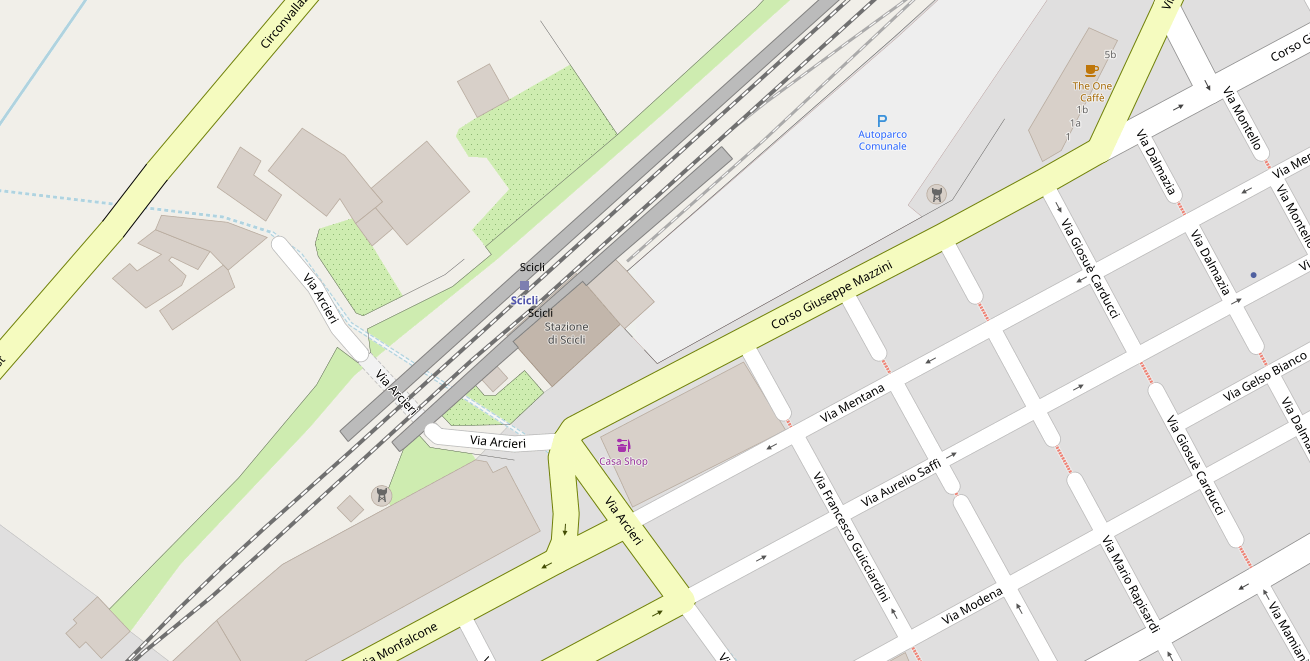
But this is where it gets interesting. In this case, I think I can check the data. Not by looking at official documents for multiple national railways — I had a quick look on Google and I couldn’t find any useful even for Britain’s railways — but by using Open Street Map.
Overpass and Open Street Map.
And that’s exactly what I did in this long twitter thread about finding railway crossing points at or near railway stations in every country on earth. It relies on a fantastic web service called overpass. And after a few days of hacking around I ended up with this query to extract the data from Open Street Map that I needed.
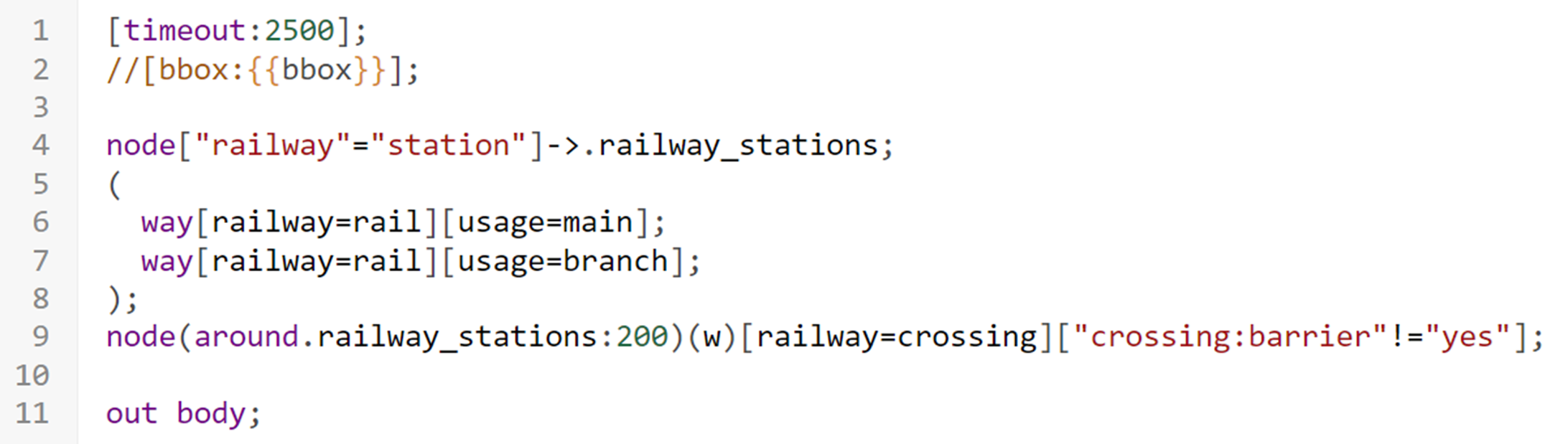
This query does the following,
- Let the query take a long time.
- Only apply the query over the area shown on the map (this is commented out and the query will run over the whole earth).
- Find all nodes that are railway stations and call them railway_stations.
- combine the results of the following two lines of code.
- select ways that are mainline railway lines.
- select ways that are branch railway lines.
- combine the results of the preceding two lines of code.
- Find all nodes within 200 metres of railway_stations that are part of mainline railway lines or branch railway lines (as defined in lines 5 to 8) that are railway crossings but that do not have a railway crossing barrier.
- Draw the result on a map.
For the whole series of development, getting help, improving, testing, and then improving some more, you can read the thread I did on twitter about this.
The key results is in the table below.
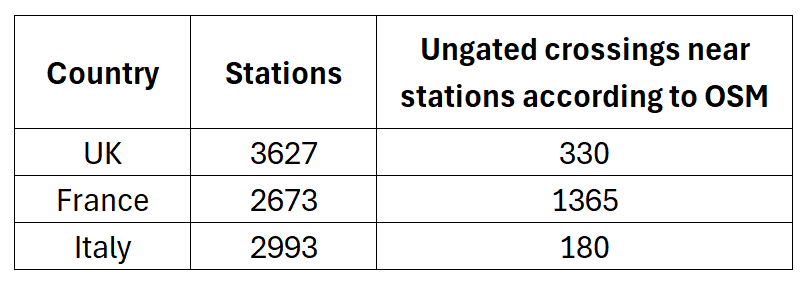
So the data from Open Street Map does seem to back up what I’ve heard about the differences between France and the UK when it comes to what I’ve now learned are called barrow crossings at stations.
But it doesn’t support what I’d heard about Italy. So I’m going to just stick to France when making comparisons in the future. I can’t be bothered to go through the whole of Open Street Map for Italy and put in all the barrow crossings that I know exist there just to get the data a bit better.
Especially since I suspect that RFI, the Italian railway infrastructure manager, probably have a spreadsheet somewhere detailing all such crossings.
Why though?
In many ways this was a stupid way to spend my free time over a week. I’ve got better things to do. Except that I don’t know of any other way to learn this kind of thing.
I have never been good at motivating myself to just learn something. I wouldn’t read a book or follow a tutorial on how to do this. I need real questions to figure out before I can force myself to overcome obstacles, even if they’re small.
Recently I gave a guest lecture at the University of Sheffield and one of the students asked me what the best way to learn programming was. I said it was to find a question, any question, you wanted to answer, figure out how to answer it, and then write up what you did. Like this.